



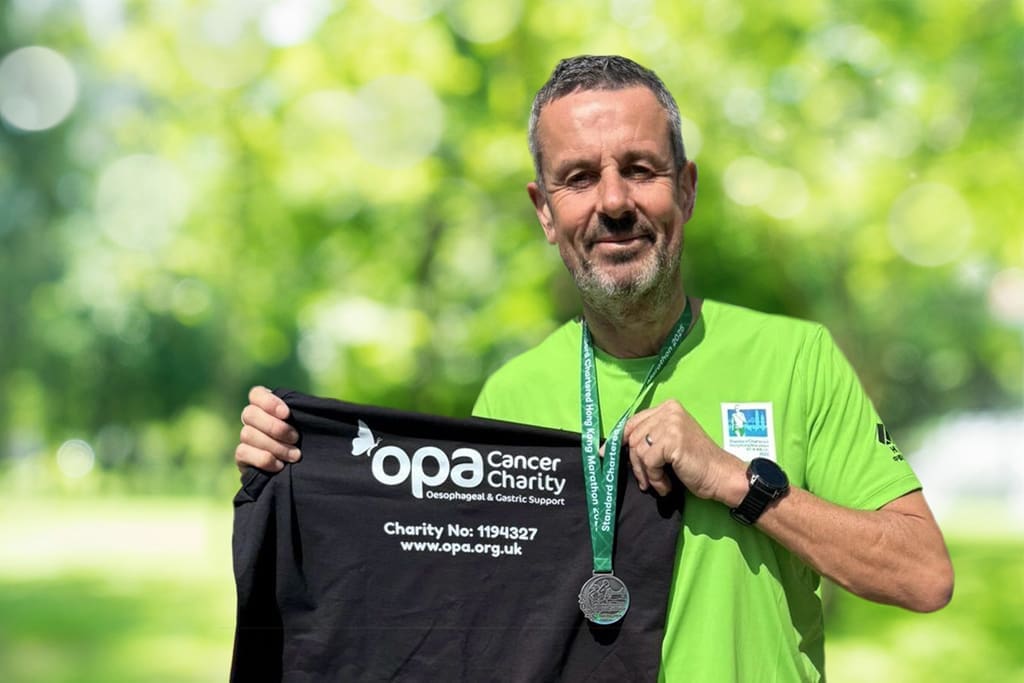




David Eaves is a member of the Leeds branch of the OPA since October 2012. Here he discusses his experiences, his work, and a topic close to his heart: whether there are hereditary factors.
I underwent my surgery in Leeds in June 2012 following diagnosis in February and treatment in April and May. Classic symptoms (difficulty swallowing, having to bring it back up, hiccups, pale appearance due to massive iron loss, fatigue) actually began in the previous October, and I knew then what they were and what it meant. Nonetheless, I didn’t want to be undergoing treatment over Christmas, because my mum was coming to visit from Stornoway where I grew up and she still lives. I managed to conceal the symptoms during Christmas dinner, which was quite an achievement. But how did I know, and why would I go to those lengths?
In August 2009, Dad died from Oesophageal cancer. Symptoms first presented earlier in the year but not knowing what it was (and being a Scottish man in his late 50s, not wanting to bother the doctors), he tried to manage the symptoms himself – cut food up smaller, chew more times before swallowing, eat more slowly, change diet. By 2006 it could not be self-managed, prompting a call to NHS24 (the Scottish equivalent of 111), an overnight hospital stay for monitoring, and tests the next day. Diagnosis was essentially immediate with a “terminal” prefix shortly after. But he stubbornly took all the treatment offered to him until two weeks before he died, when he wrote his final diary entry: “No more chemo”. The last day of my holiday back home, and the last time I saw him.
Of course, it made no difference what time of year it was when I’d tell Mum that it was my turn. It is still the single hardest thing I’ve ever had to tell anyone, and because she was 500 miles away it had to be over the phone. A lot less than ideal. Thoughts invariably turned to what caused it. Random bad luck? Chernobyl, since the fall-out in 1986 affected the North West of Scotland? Lifestyle? Hereditary? I asked at clinic and it was thought then that no, it wasn’t. My tumour was right at the oesophago-gastric junction and Dad’s was further up, and if it was hereditary it might have been expected to have been closer.
Since my involvement in the OPA, though, I’ve come across many more people who have relatives who have been affected. A retired magistrate in London whose father sadly succumbed many years ago, who himself has had successful surgery in the recent past and whose son was at that time facing treatment; a lady from Lincoln whose mother had been ill and whose daughter was suffering from Barrett’s; and word just a few hours before beginning to write this of a recent patient in North Yorkshire whose brother was facing surgery too. Are we the unlucky families? My father’s uncle died long before I was born. In those days cancer wasn’t as openly discussed as now. Was that cancer and what kind was it? My brother was recommended by a GP friend of mine to have a preemptive endoscopy. He hasn’t, but his GP knows that if he feels one is needed it will be prioritised. We know that for many cancers there are known and definitive familial links, including breast, ovarian and stomach cancers. Is it the same for oesophageal cancer, so closely related as it is to stomach cancer?
Statistically we have less-than-fantastic survival rates. If you’re a patient who’s survived surgery and are still going through the mill learning how your new “you” copes with what used to be the most simple of things, you are one of the extremely lucky and successful ones, even if it doesn’t feel like it. I know this, all too well, but it isn’t always easy to believe.
Statistically we have less-than-fantastic survival rates. If you’re a patient who’s survived surgery and are still going through the mill learning how your new “you” copes with what used to be the most simple of things, you are one of the extremely lucky and successful ones, even if it doesn’t feel like it. I know this, all too well, but it isn’t always easy to believe.