



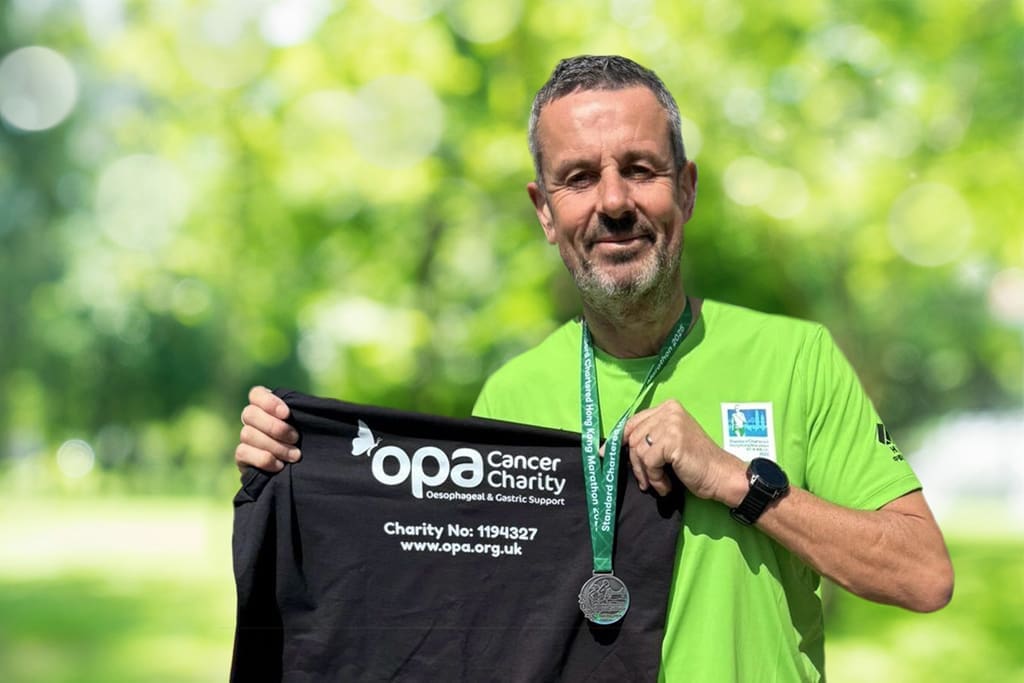



I turned 40 in May 2011 and when I started to have some slight problems with swallowing at breakfast time later that year, I initially put it down to heartburn and just getting older. It was really mild and only happened with the first meal of the day. Around February 2012 I experienced a few days of going to the toilet and it being black and only then did I feel that maybe I should go and see a doctor. My GP referred me on for an endoscopy and, following three procedures and a couple of scans, I was given the news that I had stage 3 oesophageal cancer. Lucky for me at the time I was still pretty sedated from the most recent endoscopy. For my family, who were with me, it was the worst news possible.
I strongly believe that when you are given such life changing news it really can go two ways. For me I decided there and then that I wasn’t giving in to this. I was incredibly lucky with the support of both family and friends although telling people was probably the hardest part of the whole process. You are suddenly telling people you love something that you know is going to upset them and over which neither you nor they have any control.
The next two months seemed like a whirlwind of appointments, further scans and Multi Discipline Team meetings. Initially it was thought that radiotherapy would be the best way forward but the size and position of the tumour (adenocarcinoma at the join of the stomach and oesophagus) meant that this wasn’t the best option. The consensus of opinion was that the best option would be, for me, the most drastic; chemotherapy followed by a car dio-oesphagectomy removing both my oesophagus and part of my stomach and, just for full measure, chemotherapy afterwards. A major-operation chemotherapy sandwich!
I was given all the statistics and yes there were times when it felt totally overwhelming. But the important thing for me was that these are just numbers; everyone’s journey through cancer is unique and no-one knows for sure what the outcome will be. So I decided early on to focus on the positive as much as possible. If I was told that, statistically I had a 14% chance of surviving 5 years, then I focused on being part of that 14%. I also had youth on my side; my consultant had only dealt with one person younger than myself.
The day that I started chemotherapy I felt an enormous sense of relief. At last it felt like we were fighting back. I live very close to The Christie Hospital in Manchester and the care and support that I received there was second to none. As a world leading cancer centre there couldn’t be a better place to receive treatment. Chemotherapy gave me few side effects and although the nurses had prepared me for the worst, for me, it never happened. I know that this is not the case for most people. But again everyone’s journey is different and you should never lose heart. I learnt an entirely different set of vocabulary and skills – neutrophils, patience, how to inject myself, super conscious hygiene, alternative recipes, wet wipes all become part of my daily routine.
So D-Day arrived in September 2012. The chemotherapy had reduced the tumour slightly and the operation was to go ahead. After 11 hours of surgery I awoke and was just so glad to be alive. I then spent a week in a virtual state; heavily dosed with a morphine epidural I found it difficult to separate what was real and what was imaginary. That said, due to the nature of the operation, this was probably the best state to be in. My road to recovery had begun and I slowly started to take back control, doing everything the physio said and steeling myself for the day I could drink and eat again. The body and mind are truly amazing things. Looking back there’s certain things, probably the worst moments, that I simply can’t recall and I think that’s the body’s way of protecting itself and you.
After a week I was able to drink and eat very small amounts. I always knew my will to eat would win out and each day I went from strength to strength. After another week I was discharged from hospital and spent several weeks slowly recuperating and getting back up to speed through the care of my family. On New Year’s Eve 2012 I had my final in-patient chemotherapy treatment. To be honest I’m not sure if I could have carried on for more and it felt so symbolic that this date was the last time.
There’s been ups and downs; getting used to my ‘new plumbing’, constipation followed by diarrhoea, nausea, dumping syndrome, learning what things and what amounts I can eat. But in reality, and compared to the alternative, these are such small issues and I have just learnt my own coping mechanisms. It’s a fine line between not giving in to the issue but being able to recognise any real limitations. I think it’s a work in progress but I’m getting there.
Each anniversary now is a milestone; one year after the operation, 2 years since diagnosis. I have now almost made it to the half way stage in the 5 year survival race and am about to go on holiday to New York – a long held dream which I am now making reality.
I once read that cancer means that the door to death is opened and never quite shut again. I prefer to think of it as giving you an awareness of what is important, a sense of urgency to do things now rather than put them off and an appreciation of people and the way time is spent. And that can’t be all bad.