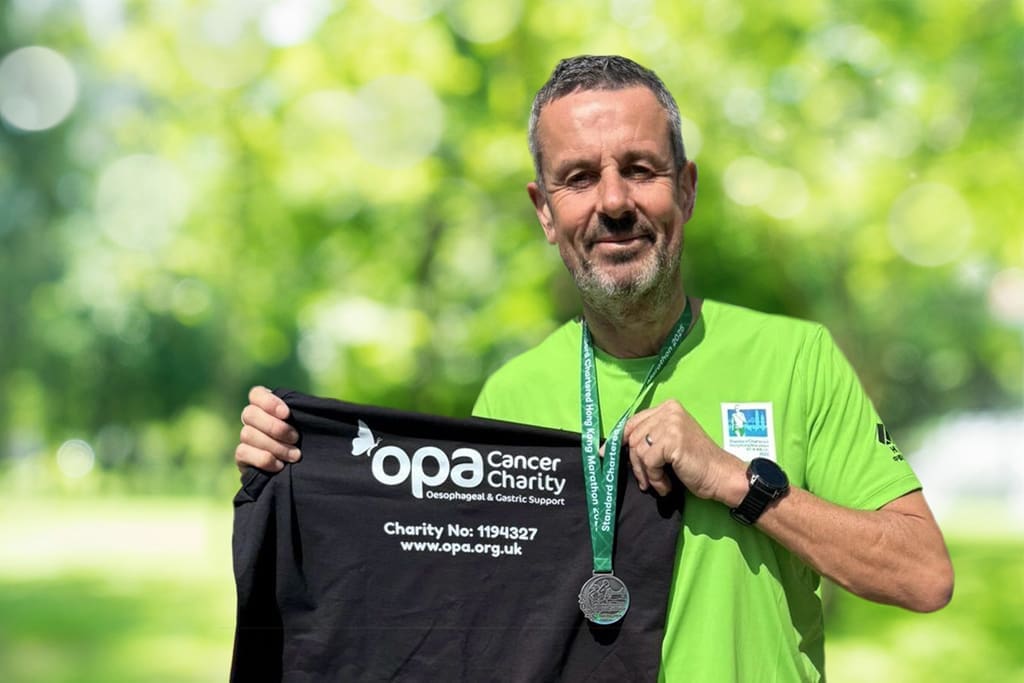
“Running the Hackney Half in memory of my grandad who passed away from oesophageal cancer. He always showed up for me, whether it was sports competitions, parents evenings, picking me up from school – now it’s time to show up for him. We miss him every day.” – Laura

Click here to support Laura’s fundraising.

Update after the Marathon

The run went so well, I had such a great time too! So many spectators cheering us all on, it was lovely to see. More importantly felt special to do for such a great cause, one close to my heart. 

Nancy’s Story

“My name’s Nancy Over, and I’ve set up this JustGiving fundraiser in memory of my Dad, Andrew Over. On September 3rd, 2024, at just 56 years old, my Dad passed away peacefully at home after his battle with oesophageal cancer, leaving behind my siblings, Toby and Darcy, and his partner, Al.

Oesophageal cancer is an incredibly aggressive disease and one that is usually caught too late. My Dad was diagnosed in December 2023 with what initially seemed like a positive prognosis, but in the following months, he was told it was terminal and was advised to make himself comfortable in hospice care. Despite everything that was thrown at him in his last nine months, his cheeky humour remained, and he didn’t complain once.

As you can imagine, this has left a huge hole in my siblings’ and my life, and we struggle to imagine a future without him. But we want to do everything we can to keep his name and memory alive.

On April 6th, I’ll be running the Brighton Marathon for the OPA Cancer Charity, which supports those affected by oesophageal and gastric cancer. Whilst it’s sadly too late for my Dad and our family, knowing that this money could help support other families going through such a gruelling experience means a lot to me. If you’re able to spare even just a couple of pounds, I’d be very grateful. Thank you x

My Dad would think I’m delusional for running a marathon – and he’s not wrong!!” – Nancy Over

Click here to support Nancy’s fundraising. 

“I ran in memory of one of my oldest friends, Paul Greaves that passed away last March (2024). Around Christmas last year he got a bad back and by the time he was diagnosed with oesophageal cancer that had spread, it was too late to save him.  He left a wife and 3 daughters and they nominated the charity after the support they received during this difficult time.  Committing to this really focused my training and after never running more than 1km before 2023, I was up at 5.30am training 5 times a week.

I completed the Hong Kong Standard Chartered Half marathon in under two and a half hours which was my target and I’m grateful to everyone that supported and sponsored me along the way.” – Andrew Woodfine

Abstract

Background

Long-term symptom burden and health-related quality-of-life outcomes after curative oesophageal cancer treatment are poorly understood. Existing tools are cumbersome and do not address the post-treatment population specifically. The aim of this study was to validate the six-symptom LASORS tool for identifying patients after curative oesophageal cancer treatment with poor health-related quality of life and to assess its clinical utility.

Methods

Between 2015 and 2019, patients from 15 UK centres who underwent curative-intent oesophageal cancer treatment, and were disease-free at least 1 year after surgery, were invited to participate in the study and complete LASORS and European Organisation for Research and Treatment of Cancer QLQ-C30 and QLQ-OG25 questionnaires. Receiver operating characteristic curve analysis was used to examine the accuracy of the LASORS tool for identifying patients with poor health-related quality of life.

Results

A total of 263 patients completed the questionnaire. Four of the six LASORS symptoms were associated with poor health-related quality of life: reduced energy (OR 2.13 (95% c.i. 1.45 to 3.13)); low mood (OR 1.86 (95% c.i. 1.20 to 2.88)); diarrhoea more than three times a day unrelated to eating (OR 1.48 (95% c.i. 1.06 to 2.07)); and bloating or cramping after eating (OR 1.35 (95% c.i. 1.03 to 1.77)). The LASORS tool showed good diagnostic accuracy with an area under the receiver operating characteristic curve of 0.858 for identifying patients with poor health-related quality of life.

Conclusion

The six-symptom LASORS tool generated a reliable model for identification of patients with poor health-related quality of life after curative treatment for oesophageal cancer. This is the first tool of its kind to be prospectively validated in the post-esophagectomy population. Clinical utility lies in identification of patients at risk of poor health-related quality of life, ease of use of the tool, and in planning survivorship services.

Read more here.

This article is from British Journal of Surgery | Oxford Academic

This week, we’re shining a light on acid reflux, a condition that affects millions. From raising awareness of symptoms to sharing tips for managing it, we’re here to support patients, caregivers, and families every step of the way.

Stay tuned for informative posts and resources throughout the week! Let’s work together to spread awareness and empower those affected.

Follow us and share, and together we can make a difference.

https://www.instagram.com/opacancercharity/

https://www.facebook.com/profile.php?id=100085473095319

https://x.com/OPA_UK

Professor Grant Fullarton – OPA Trustee

Grant has taken up an advisory post with the Scottish Government as the Clinical Lead for General Surgery. Grant has managed to introduce the Cytosponge in NHS Scotland as a National Service. The Cytosponge, now known as EndoSign, is a new technique to screen Barrett’s oesophagus patients.

Grant is the former lead Oesophago-Gastric Consultant Surgeon in Glasgow Royal Infirmary with major interests in management of malignant and complex benign upper GI disease. Grant is a former Associate Professor of Clinical Surgery with extensive research interest in benign and malignant upper GI disease. His particular interest is in the field of Barrett’s oesophagus including its role in cancer development and treatment with Radiofrequency Ablation.

Scotland to become first country to offer widespread capsule sponge testing for the detection of oesophageal cancer and Barrett’s oesophagus

  • EndoSign® capsule sponge technology allows patients suffering from heartburn to get a quick and easy diagnosis of oesophageal cancer and Barrett’s oesophagus
  • Sponge capsule can also be used to risk stratify known Barrett’s cases allowing identification of serious pathology with significant reduction in endoscopy requirements 
  • Over 4,000 capsule sponge tests were performed during the pilot programme, increasing concerning test results found at endoscopy from under 10% to over 50% 

NHS Scotland through the CytoScot program  has introduced the national adoption of capsule sponge test technology across all 14 health boards. The test is currently available to patients in secondary care with known Barrett’s oesophagus or severe reflux where there is suspicion of Barrett’s or early cancer .  This will ensure the early diagnosis of oesophageal cancer and Barrett’s oesophagus is readily available to patients across Scotland.

The capsule sponge test takes less than ten minutes and can help ensure that oesophageal cancer and precancerous conditions are quickly detected and treated. It will vastly improve the availability of vital diagnostic services for patients suffering from chronic heartburn, which could be a sign of Barrett’s oesophagus, a condition that carries a high risk of developing oesophageal cancer. 

Patients swallow a capsule the size of a multivitamin pill containing a small sponge on a strong thread, which collects cell samples for analysis. The test reduces the need for invasive endoscopies which can often require a lengthy hospital visit and sedation, limiting access for certain patients. Patients have found the sponge test to be simple and more acceptable than endoscopy.

Capsule sponge testing has helped provide more targeted care for patients, cutting waiting times and boosting clinical capacity as demand for endoscopy is reduced and detection rates increase. In addition there are major health economic benefits with significant cost savings by moving to a capsule sponge diagnostic service.

Patients suffering from persistent heartburn, or indigestion should be aware that these could be symptoms of Barrett’s oesophagus, or even oesophageal cancer, and should speak with their GP about being referred for a capsule sponge test. 

Many patients currently have to travel long distances to receive an endoscopy, but the option of taking the capsule sponge test, which can be delivered in community settings closer to home, means that unnecessary travel can be avoided if Scotland chooses to offer the service in primary and community care.

In 2020, gastrointestinal health company Cyted and NHS Scotland launched a pilot programme with the goal of detecting oesophageal cancer at an earlier stage, reducing the demand for endoscopy services and improving patient access to vital diagnostic services. Approximately 4,000 tests were delivered during the four-year programme. As a result of the improvements to patient triage, 1 in 2 endoscopies now find concerning pathologies compared with 1 in 10 before, waiting times have been cut from nine to five months, with more early vs late stage abnormal cell changes being detected.

“It’s great to have the support of NHS Scotland, and we are excited to continue working closely to see how the technology can help further improve access to early cancer detection for patients,” said Dr Marcel Gehrung, CEO and Co-founder at Cyted. “This is the first national roll-out of many and we are scaling globally to realise the full potential of patient impact for our technology.”

Under the roll-out, approximately 5,000 tests are expected to be delivered per year for the first two years, which will then be increased to 8,000 per year. Scaling up the number of tests deployed will allow more patients to be tested, helping identify a greater number of patients at risk of developing oesophageal cancer. There are around 9,300 new oesophageal cancer cases in the UK every year. The key to saving lives is to detect cancer at an earlier stage of Barrett’s oesophagus before it becomes cancerous.

“The development of the capsule sponge test has been a major breakthrough in improving early diagnosis of pre and early oesophageal cancer in Scotland. It has prioritised patients care where a rapid diagnosis is critical. We hope that ultimately this will lead to improved survival in this  high mortality cancer “- Professor Grant Fullarton, Clinical Lead CytoScot NHS Scotland spokesperson.

This guideline covers investigating and managing gastro-oesophageal reflux disease (GORD) and dyspepsia in people aged 18 and over. It aims to improve the treatment of GORD and dyspepsia by making detailed recommendations on Helicobacter pylori eradication, and specifying when to consider laparoscopic fundoplication and referral to specialist services.

Dyspepsia describes a range of symptoms arising from the upper gastrointestinal (GI) tract, but it has no universally accepted definition. The British Society of Gastroenterology (BSG) defines dyspepsia as a group of symptoms that alert doctors to consider disease of the upper GI tract, and states that dyspepsia itself is not a diagnosis. These symptoms, which typically are present for 4 weeks or more, include upper abdominal pain or discomfort, heartburn, gastric reflux, nausea or vomiting. In this guideline, gastro-oesophageal reflux disease (GORD) refers to endoscopically determined oesophagitis or endoscopy-negative reflux disease.

Continue reading…

This information is from NICE, National Institute for Health and Care Excellence – Homepage | NICE

A growing epidemic of preventable cancers will lead to 184,000 people in the UK being diagnosed with the disease this year and will cost the country more than £78bn, research reveals.

The cost of the cancer cases diagnosed in 2023 caused by smoking, drinking, obesity and sunburn leads to £40bn in lost productivity, costs the people affected £30bn and takes up £3.7bn of the NHS’s budget, the study found. Preventable cancers also cost families and carers £3.4bn and the social care system £1.3bn.

The stark findings sparked calls by doctors and public health campaigners for a crackdown on smoking, drinking and poor diet to reduce avoidable cancers because of the huge human toll they involve and their financial consequences.

Continue Reading…

This article is from the Guardian- 184,000 in UK to get preventable cancer diagnosis this year, study finds | Cancer | The Guardian

^(A UHS nurse, Danielle Harding, and consultant general and oesophagogastric surgeon at UHS Fergus Noble. Danielle Harding, 30, is the first patient with gastro-oesophageal reflux disease to undergo the RefluxStop procedure at UHS (University Hospital Southampton/PA Wire)

The first patients in the UK have had a new device implanted to prevent severe acid reflux disease.

University Hospital Southampton (UHS) and Imperial College London have become the first NHS trusts in the country to install the device called the RefluxStop, with Southampton being the first to use robotic surgery for the procedure.

Known as gastro-oesophageal reflux disease (GORD), the condition occurs when contents from the stomach flow back into the oesophagus – the long tube that carries food from the throat to the stomach.

This can result in a range of symptoms including heartburn, regurgitation, difficulty swallowing, bloating, excessive salivation, coughing, nausea and a hoarse voice, as well as teeth and gum damage, nutritional problems, and sleep impairment.

It happens when the muscular valve – the lower oesophageal sphincter – at the bottom of the oesophagus becomes weakened because it has moved too close to the diaphragm or even into the chest which affects its function to allow food in and stop acid leaking out.”

This article is from the Independent, to continue reading click here – First patients in UK receive revolutionary device to stop acid reflux and heartburn | The Independent

If you would like more information on RefluxStop, check out our leaflet here- RefluxStop Leaflet – The OPA

“Findings from the phase 3 ESOPEC trial demonstrate an overall survival advantage with a perioperative chemotherapy regimen known as FLOT compared with a neoadjuvant chemoradiation approach, called CROSS, in patients with resectable, locally advanced esophageal adenocarcinoma.

The study results, presented as a late-breaking abstract at the American Society of Clinical Oncology (ASCO) annual conference, help settle a long-standing debate about whether chemotherapy with FLOT — 5-florouracil, leucovorin, oxaliplatin, and docetaxel — before and after surgery, or neoadjuvant radiation plus CROSS — carboplatin and paclitaxel — followed by surgery is the best approach.

There has been “considerable disagreement as to whether giving all adjuvant therapy upfront versus ‘sandwich’ adjuvant therapy before and after surgery is the better standard of care for locally advanced resectable esophageal cancer,” Jennifer Tseng, MD, of Boston Medical Center, Boston, said in an ASCO press release. This randomized clinical trial shows the sandwich approach “provides better outcomes.”

The practice-changing ESOPEC findings will have an important effect on the management of patients with resectable esophageal adenocarcinoma and gastroesophageal junction adenocarcinoma, but local and distant failures remain a challenge in this population, explained invited discussant Karyn A. Goodman, MD.

Advances since the initiation of ESOPEC — such as immunotherapy options and personalized strategies — suggest the esophageal adenocarcinoma story is still evolving, said Goodman, professor and vice-chair of research and quality in the Department of Radiation Oncology at Icahn School of Medicine at Mount Sinai, New York City.

The ESOPEC trial

Both the FLOT and CROSS regimens are established standards of care in resectable esophageal adenocarcinoma, and the choice of treatment has largely varied based on geographical location.

The current randomized, prospective, open-label ESOPEC trial, however, demonstrated that FLOT can prolong overall survival, first author Jens Hoeppner, MD, from the University of Bielefeld in Detmold, Germany, reported.

Overall, 438 patients with locally advanced, resectable esophageal adenocarcinoma recruited between February 2016 and April 2020 from 25 sites in Germany and randomized to either FLOT (n = 221) or CROSS (n = 217). The median age was 63 years, and most (89.3%) were men. Patients were followed until November 2023, and median follow-up was 55 months.

Patients in the FLOT arm received four cycles — one every 2 weeks for 8 weeks —followed by surgery 4-6 weeks later. FLOT cycles were reinitiated 4-6 weeks after surgery and given every 2 weeks for 8 weeks.

Those in the CROSS arm received one cycle per week of radiation therapy for 5 weeks plus carboplatin and paclitaxel followed by surgery 4-6 weeks after the last cycle.

Overall, 86% received both neoadjuvant therapy and surgery in the FLOT arm vs 82.9% in the CROSS group. Among these patients, 16.8% in the FLOT group achieved a pathological complete remission vs 10.0% in the CROSS arm.

In the intention-to-treat population, median overall survival was almost twice as long in the FLOT group — 66 months vs 37 months. At 3 years, those who received FLOT had a 30% lower risk of dying (hazard ratio [HR], 0.70), with 57.4% patients alive at that point compared with 50.7% patients in the CROSS arm.

The 5-year overall survival was 50.6% in the FLOT group vs 38.7% in the CROSS group.

Patients receiving FLOT also demonstrated improved progression-free survival (PFS), with a median PFS of 38 months vs 16 months. The 3-year PFS was 51.6% with FLOT vs 35.0% with CROSS (HR, 0.66). The exploratory subgroup analyses for sex, age, ECOG status, and clinical T and N stages also favored FLOT.

The 30-day postoperative mortality was 1.0% in the FLOT group and 1.7% in the CROSS group, and the 90-day postoperative mortality rate was 3.2% and 5.6%, respectively.

Based on these findings, perioperative chemotherapy with FLOT should be preferred over neoadjuvant chemoradiation with CROSS, Hoeppner concluded.

Goodman agreed, noting that, in the wake of ESOPEC, FLOT will likely be adopted as a more standard approach in the United States for patients who are fit. And, for patients who are not candidates for FLOT, CROSS is a reasonable option, she said.

But, she asked, does it really have to be an either/or situation?

Multiple studies, including Goodman’s 2021 Alliance/CALGB 80803 study, have demonstrated promising outcomes with combined modalities and adapting therapy based on treatment response. Several trials, for instance, are evaluating combining FLOT and CROSS, with some showing the approach is feasible and comes with manageable toxicity.

It’s also important to look outside of FLOT and CROSS. During ESOPEC, new approaches entered the treatment landscape, including the use of adjuvant immunotherapy following neoadjuvant chemoradiation and surgery for noncomplete response.

Take the CheckMate 577 study, which found that adjuvant nivolumab immunotherapy after preoperative CROSS and surgery significantly reduced metastatic recurrence and doubled disease-free survival in patients who did not achieve a complete response. This approach is now a standard of care for those patients.

FLOT plus neoadjuvant nivolumab may also be a viable option, Goodman noted, but we haven’t yet seen “any benefit in survival with the combo of chemotherapy and immunotherapy for resectable esophago-gastric cancer.”

Further studies are needed to evaluate the synergy of immunotherapy and radiotherapy. The next chapter of the esophageal adenocarcinoma story may feature a “best-of-both-worlds” approach that combines induction chemotherapy, followed by personalized chemoradiation, surgery, and potentially adjuvant immunotherapy, Goodman explained.

While the ESOPEC findings are impressive, the 5-year overall survival of only 50% is still suboptimal, she noted. “Given the poor prognosis with this disease, we need to continue to develop clinical trials to identify better targets, novel treatment combinations, and select patients that will respond best to specific treatment.”

ESOPEC was funded by the Deutsche Forschungsgemeinschaft (German Research Foundation). Hoeppner reported receiving travel, accommodations, and expenses from Intuitive Surgical. Goodman reported a relationship with the national Cancer Institute and consulting or advisory roles for Novartis, Philips healthcare, RenovoRX, and Roche/Genentech.”


This article is from: Medscape Registration