At OPA Cancer Charity, we provide vital support to individuals diagnosed with oesophageal cancer, as well as their caregivers, families, and loved ones. Alongside our support services, we work tirelessly to raise awareness of oesophageal cancer, with the aim of encouraging earlier diagnosis and improving survival rates.

Understanding Oesophageal Cancer

Oesophageal cancer affects the gullet – the tube that carries food from the throat to the stomach. Over the past 40 years, the prevalence of this cancer has increased significantly. There are around 9,400 new oesophageal cancer cases in the UK every year, that’s 26 every day (2017-2019, CRUK) making awareness and early detection more important than ever.

Recognising symptoms early can make a real difference. By increasing understanding of oesophageal cancer, we hope more people will seek medical advice sooner and access the support they need.

Raising Awareness This February

This February, during Oesophageal Cancer Awareness Month, we encourage everyone to take time to learn more about the signs and symptoms of oesophageal cancer, as well as the support and resources available for patients and families.

To help spread awareness, we have an Oesophageal Cancer Awareness Information Pack, designed for individuals, community groups, healthcare settings, and organisations who want to help share important information and show their support.

To order your awareness packs, please visit our online shop:
https://opa.org.uk/product/oesophageal-cancer-awareness-pack/

Together, We Can Make a Difference

By raising awareness, sharing information, and supporting one another, we can help improve understanding of oesophageal cancer and make a meaningful difference for those affected.

Thank you for joining us this February and for helping to raise awareness of oesophageal cancer.


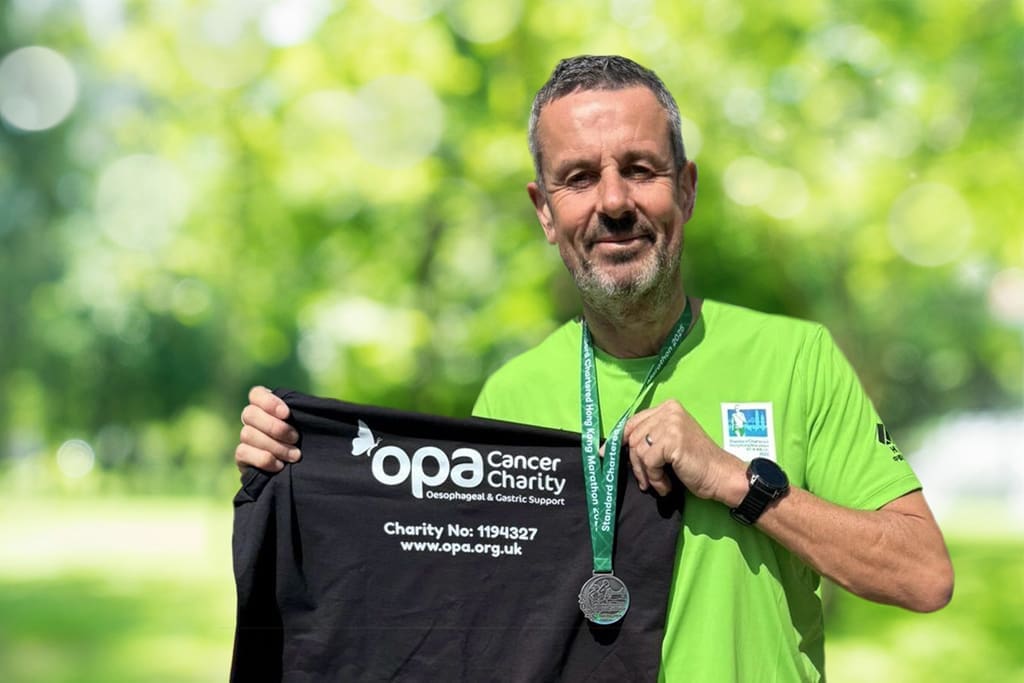
A huge thank you to Chloe Chivers for taking on the incredible Paris Half Marathon 2026 in support of the OPA Cancer Charity.

Chloe’s Story

“In June 2019, my Grandad was diagnosed with oesophageal cancer after struggling to swallow his food. He underwent four rounds of chemotherapy before having surgery to remove the tumour.

During this difficult time, the OPA Cancer Charity reached out to offer invaluable support and guidance. Through the OPA, my Grandad connected with others who had been through similar experiences, helping him feel less alone on his journey.

In February 2025, we received the best news — my Grandad was discharged from oncology and declared cancer free.

Since then, my grandparents have continued to work closely with the OPA, raising awareness and supporting others facing their own cancer battles. I’m incredibly grateful for the care and encouragement the OPA provided to my Grandad and our family during such a challenging time.

Thanks to the OPA, there is now greater awareness of oesophageal cancer and its early symptoms, giving more people the chance of earlier diagnosis and better outcomes.

I’m taking part in this event to help raise awareness and funds for the OPA so they can continue their amazing work supporting patients and families across the UK.

Every donation, big or small, helps the OPA continue their mission — thank you so much for your support!”

If you would like to support Chloe’s fundraising journey, please click here.

Thank you so much to everyone at Friends Music for their incredible support of the OPA Cancer Charity.

Friends Music organises a wonderful monthly series of concerts at the Quaker Meeting House in Welwyn Garden City, bringing people together through music while supporting meaningful causes.

In December, audiences were treated to a performance by Quatuor Petrus, led by Consultant Gastroenterologist Dr Maxton Pitcher, who kindly chose to support the OPA Cancer Charity.

Thanks to this special evening, the OPA received a generous donation towards the important work we do, and we are truly grateful for the support. Fundraising efforts like this help us continue providing vital services and making a real difference for those affected by oesophageal and gastric cancers.

Our heartfelt thanks once again to Friends Music, Dr Pitcher, and everyone who attended and supported the concert — proof that music really can change lives.

We’re delighted to announce our support for the launch of the ‘Heartburn Health’ programme — a major UK-based research initiative dedicated to improving care for people experiencing heartburn, acid reflux or indigestion. This programme aims to build a community of volunteers, gather data on symptoms and treatments, and enable future studies that may lead to better detection, management and outcomes.

About the programme

Heartburn health is the leading research into heartburn, indigestion & acid reflux – 70,000 people are already taking part in the UK’s largest research programme into heartburn, indigestion and acid reflux. The NHS and Cancer Research UK are supporting this research programme​. Taking part could be the difference in improving future care.​

To improve care for people with heartburn, indigestion and acid reflux, the University of Cambridge, Cambridge University Hospitals NHS Foundation Trustand Queen Mary University of London are working with the NHS to set up Heartburn Health.

Heartburn Health aims

Heartburn, indigestion and acid reflux are common symptoms. They can cause daily discomfort and sometimes need long-term medication (e.g. Omeprazole or Gaviscon). In rare cases, these symptoms can lead to more serious health problems.

This programme will build a community of volunteers with heartburn. This will allow experts to research issues like how to manage symptoms, improve medication and detect more serious health problems early (e.g. cancer), when they are easier to treat.

Find out more – https://www.heartburnhealth.org/

Celebrating 40 Years
with Fiona Wade

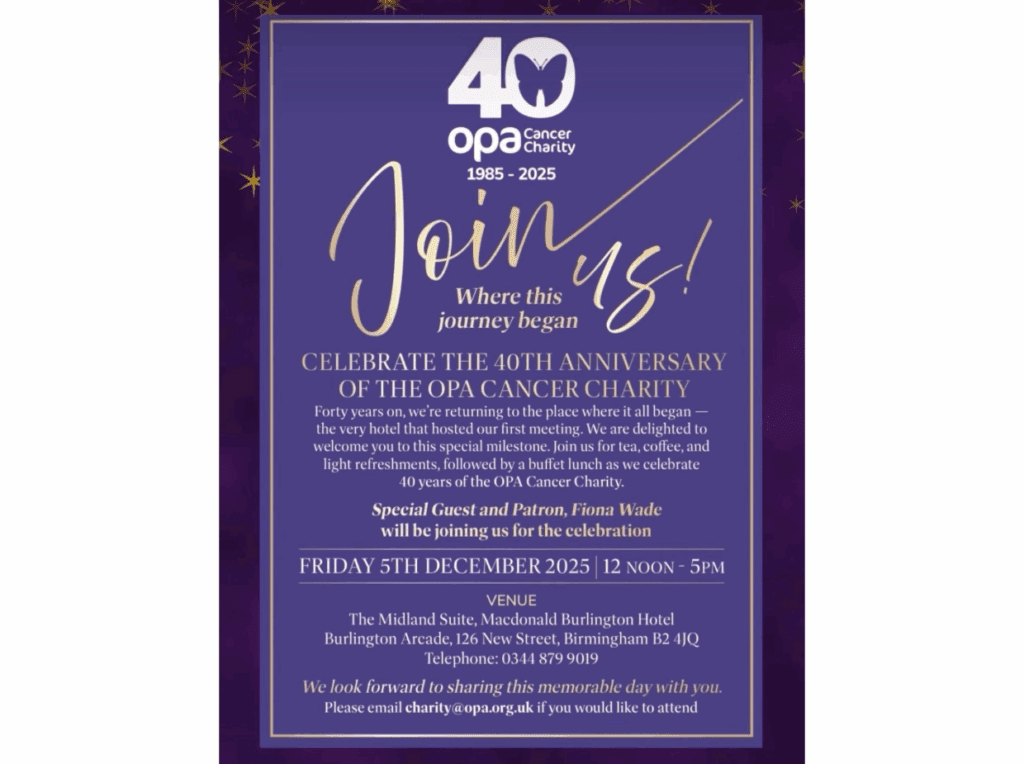
The absolute highlight of our year was celebrating four decades of the OPA. We were delighted to have our Patron, Fiona Wade, join us for our anniversary event. This took place at the Macdonald Burlington Hotel, Birmingham where it all began, which truly made the occasion special. It was a wonderful opportunity to look back on 40 years of providing a vital voice for patients and families. Since 1985, our mission to raise awareness and support those affected by oesophageal and gastric cancers has remained unchanged.

From Crisis to a
New Digital Home

While we celebrated our history, 2025 also brought a moment of extreme stress. We were notified on a Friday afternoon at 4:00 PM that our previous website company had gone into liquidation. However, we turned that challenge into a new beginning. We have been rebuilding our website from scratch, and we want to extend a massive thank you to our amazing website and  IT teams for their incredible support throughout 2025. Their dedication ensured we stayed connected to you during a very difficult transition.

Our 2025 Awareness  Campaigns

Despite the technical hurdles, our advocacy remained at the forefront. This year, we successfully delivered three major campaigns:

  • February: Oesophageal Cancer Awareness Month.
  • November: Acid Reflux Awareness & Gastric (Stomach) Cancer Awareness.
Our Commitment: Free Resources for All

This year has been exceptionally busy and successful for our fundraising efforts, and we want to be transparent about how those funds are used. Our absolute priority is ensuring that every penny raised goes directly towards providing free literature and resources to those who need them most.

To make sure vital information is never placed behind a paywall, we focus our funding on creating and distributing high-quality resources at no cost. As a result, we are not currently able to commit funds to direct research; instead, we ensure all our materials are freely available to:

  • Patients and caregivers navigating a diagnosis
  • NHS healthcare professionals, including Macmillan cancer nurses
  • Maggie’s Centres, Private Clinics, Charities, & support groups across the UK
Involving You in Research

While our finances are dedicated to these free resources, we still believe research is vital. We take great pride in involving our community in participating in important research initiatives. By taking part in these projects, you help shape the future of care.

Support Our 40 Year Appeal

To help us continue providing free information and support to those affected by oesophageal and gastric cancers, we have launched our 40 Year Appeal. If you are able to donate, your support will help ensure our vital resources remain freely available.

Looking Ahead to 2026

We are entering the new year with a fresh brand, a new website, and 40 years of momentum. We are already concentrating on some exciting new initiatives for 2026 that we can’t wait to share with you.

Thank you to all our donors, supporters, and friends for an incredible year. Have a lovely Christmas and a peaceful New Year—we look forward to a bright and exciting 2026 together!

With heartfelt gratitude,
The OPA Cancer Charity Team


During the Christmas holidays, it’s important to stay safe and know where to turn if you need help.

If you or someone you care about is feeling unwell, in crisis, or needs urgent support, these numbers are available.

Keeping these numbers handy can provide reassurance and guidance, helping you and your loved ones enjoy the festive season with peace of mind.

Written by Louise Peers, PGDip Sleep Medicine and HCPC-registered Clinical Sleep Scientist, this leaflet offers clear, evidence-based and practical guidance to help you understand how everyday food choices can support your sleep and overall wellbeing in a gentle, realistic way. It is designed to cut through conflicting advice and provide simple, supportive information that can be used alongside healthy sleep habits.

Order your free of charge leaflet from the OPA Shop – https://opa.org.uk/product/sleep-and-food-leaflet/

Prioritising research for cancers of the oesophagus and stomach
Christopher M. Jones; University of Cambridge

What do you think researchers should focus on to improve the care provided to patients with cancers of the oesophagus (gullet) or stomach?

There is no doubt that more research is needed and that there are many questions about these cancers that need answering. These relate to all parts of a patient’s journey. This includes questions relating to how to prevent oesophageal and stomach cancers, how to diagnose and treat them more effectively, and how to support people after they have received treatment.

There are unfortunately not enough resources to focus on each of these questions at once. This means we must decide which areas are the most important to focus on first.

Deciding which topics to focus on is difficult. Patients often have different views on what is important to the people looking after them in the healthcare team. This means it is important that we choose areas to research based on what patients and their wider family members think as well as what each member of the healthcare team considers important.

The UK & Ireland Oesophagogastric Group (UKIOG) recognised this and a wider need to find research priorities. To address this, we set up a project to work with patients, people with lived experience of these cancers and healthcare professionals to together agree on which research questions are most important. We also worked closely with charities such as the OPA Cancer Charity (previously known as the Oesophageal Patients Association) to achieve this. With their help, we designed and sent out a survey that asked patients to tell us areas that they thought needed more research.

A total of 455 people took part in this survey and between them suggested over 4000 areas of research. We looked at these areas and grouped them into 92 similar questions. We then asked patients and healthcare professionals to rank which questions mattered most to them. Patients’ views were given strong importance. As a result of this survey, 22-46% of research priorities from healthcare professionals changed.

At the end of this process, we created a list of the top 20 research priorities for oesophageal and gastric cancer. We also created separate lists for research on the prevention, diagnosis and treatment of these cancers, as well as for palliative care or improving long-term side effects.

This work has taken many years but was published in 2025. We hope that the results will help ensure that researchers and funding organisations focus on research that will make the most difference to patients.

The top 20 priorities are as follows:

  1. Which combinations of treatments work best for people with oesophageal or stomach cancer?
  2. Which people with oesophageal or stomach cancer should be offered immunotherapy?
  3. Who should have extra treatment after surgery or radiotherapy?
  4. What is the best way to help people maintain good nutrition during treatment for oesophageal or stomach cancer?
  5. Who should be checked (screened) for oesophageal or stomach cancer?
  6. What is the best way to treat oesophageal or stomach cancer when it is found early?
  7. What is the best way to treat Barrett oesophagus (a condition that sometimes leads to oesophageal cancer) when there is a high risk it could turn into cancer?
  8. How can treatment be better tailored to each person with oesophageal or stomach cancer?
  9. Are there some people with oesophageal or stomach cancer who could safely avoid surgery, and how can this be done?
  10. Why are more younger people being diagnosed with oesophageal or stomach cancer?
  11. How can we best support nutrition in people with oesophageal or stomach cancer that cannot be cured?
  12. What is the best way to prepare people for oesophageal or stomach cancer treatment before it starts?
  13. What helps most to improve quality of life and control symptoms for people with oesophageal or stomach cancer that cannot be cured?
  14. What is the best way to check and monitor people with Barrett oesophagus?
  15. Does preparing people before treatment improve their long-term health after oesophageal or stomach cancer treatment?
  16. What prevents oesophageal and stomach cancers from being found earlier?
  17. How can we best support long-term nutrition in people after treatment for oesophageal or stomach cancer?
  18. How can we reduce long-term side effects after surgery for oesophageal or stomach cancer?
  19. What is the best way to monitor people after oesophageal or stomach cancer treatment to spot cancer coming back early?
  20. How can new surgical treatments reach people with oesophageal or stomach cancer more quickly and safely?

If you would like to learn more about the UK & Ireland Oesophagogastric Group, please visit https://ukiog.co.uk/. This project was led by Dr Christopher Jones (Clinical Lecturer, University of Cambridge) and Mr Christopher Peters (Clinical Associate Professor, Imperial College London), along with a large group of healthcare professionals, scientists and patients. We are very grateful for their time and for every patient and healthcare professional who responded to our surveys to help make this project a success.

The results for this survey can be found below.

Research priorities summary_charities

Research priorities_Gut

Thank you so much to Simon, Moraig and Fiona for choosing to support the OPA Cancer Charity in your fundraising throughout December. We are so grateful!

“Our Dad and father in law, Ronald was diagnosed with Oesophageal cancer in December 2010 when he was 56 years old. At the point of diagnosis unfortunately surgery was not possible. Dad bravely endured a year of treatment to give him some time with family, especially his young grandchildren. He sadly passed away on 17 December 2011. When we heard about OPA cancer charity we decided to fundraise as we recognise the work you do to prevent others from losing their loved ones like we have. Our Dad was amazing and we miss him every day. We are proud to walk 10km a day (Fiona is going 10k steps a day) to raise money and awareness for OPA cancer charity.”

Simon Piggot, Moraig Piggot & Fiona Small

Click here to view their fundraising page.

We were deeply honoured to welcome our patron, Fiona Wade, to our 40-year anniversary celebration. Fiona’s presence added warmth and meaning to this milestone, and we are incredibly grateful she could join us. As we reflected on four decades of growth, community, and shared achievements, having her with us reminded everyone of the commitment and encouragement that helped shape our work.

Fiona, known to many from her long-running role as Priya Sharma on Emmerdale, has more recently been seen taking on a variety of roles in theatre, showcasing her talent on stage. Alongside her work in television and theatre, she continues to be a committed advocate for those affected by oesophageal and gastric cancers. Her support is shaped by her own personal experience of losing her father to oesophageal cancer, and she uses her voice to help raise awareness and understanding.

Thank you for celebrating this milestone with us. We look forward to the future with appreciation for all who stand beside us.